

























Digital PR and AI search: how to earn citations, mentions and backlinks that build trust in your brand
Giada Luna Giallombardo16 min read

IN SHORT
The answers given by ChatGPT, Gemini and AI Overviews rely mostly on third-party sources: according to Muck Rack, 84% of citations come from earned media, and for Ahrefs brand mentions across the web are the factor most correlated with appearing in AI Overviews (0.664, against 0.218 for the number of backlinks). Digital PR is about appearing in those sources: proprietary data, expert bylines, trade publications, associations, communities. It's measured through mentions, share of voice in AI, branded searches and referrals.
Topic of our service GEO · Optimisation for AI Overviews and ChatGPT
Ask ChatGPT who the best suppliers of a particular industrial component in Italy are and look at the sources below the answer. They’re rarely the websites of the companies mentioned. They’re articles from trade publications, association directories, Reddit threads, LinkedIn posts, the odd Wikipedia entry. Your website can be perfect and still be left out, because AI prefers to hear about you from someone else.
The short answer is this: to get cited by AI, you need credible third-party sources to talk about your brand and connect it to the topics it works on. Digital PR is the work of building that presence methodically, with content that deserves to be picked up, relationships with the people who publish it and measurement that goes beyond counting links.
When I started writing editorial plans, PR and SEO lived in different rooms. Today, what a trade publication writes about you ends up in the answer a procurement director reads before opening your website.
Why does AI cite others more than your own website?
Answer engines trust what independent third parties say about a brand more than what the brand says about itself. The available data all points the same way: citations come largely from media, encyclopaedias, communities and professional platforms.
Three studies help to show the scale of the phenomenon:
- Muck Rack, in its May 2026 report What Is AI Reading? (the figures are in the launch press release of 7 May), analysed more than 25 million links cited by ChatGPT, Claude and Gemini across 17 sectors. 84% of citations come from earned media (journalism, research, institutional sources, encyclopaedias, third-party content); journalism alone accounts for 27%, paid content and advertorials for 0.3%. More than half of journalistic citations are of articles published in the previous twelve months.
- Ahrefs in May 2025 studied 75,000 brands to understand what goes along with appearing in Google’s AI Overviews. The strongest correlation is with brand mentions across the web (0.664), followed by anchor text containing the brand name (0.527) and branded search volume (0.392). The number of backlinks comes in at just 0.218. It’s a correlation, not proof of cause, but it shows where to look.
- Semrush tracked more than 230,000 prompts between July and October 2025 on ChatGPT search, Google AI Mode and Perplexity: Reddit and LinkedIn appear among the five most cited domains on all three platforms, with Wikipedia, YouTube, Medium and Forbes following depending on the engine.
Your website is still the foundation (we cover this in our guide to GEO), but the decision about whom to cite is also made outside it, where reputation is formed. This is the least technical side of generative engine optimisation.
Mentions, citations and backlinks: what’s the difference?
A mention is your brand name written on a third-party site, with or without a link. A backlink is a hyperlink to your website. An AI citation is your brand or one of your pages appearing within a generated answer. They’re three different things and need to be looked after together.
| Signal | What it is | What it brings for Google | What it brings for AI | How you get it |
|---|---|---|---|---|
| Unlinked mention | The brand named in an article, a list, a post | Context and awareness, no value passed through a link | Associates the brand with a topic and a sector, feeds the answers | Interviews, cited data, presence at trade fairs and in associations |
| Editorial backlink | A link added by an editorial team or an independent author | Authority and page discovery | Makes your pages reachable as a source | Original content, research, useful resources |
| Citation in an AI answer | The brand or a page among the sources of ChatGPT, AI Overviews, Perplexity | Indirect | It’s the result you measure | The sum of the previous signals plus citable pages |
| Review or community discussion | Opinions on Google, G2, Reddit, industry forums | Local and product trust | A frequent source for comparison questions | Satisfied customers who are asked to write |
A “backlinks only” view ignores the first and last rows, which are precisely the material a language model uses to describe a company.
Which content gets cited by journalists and AI?
The content that gets cited is the content that contains something you can’t find elsewhere: a number, an expert opinion, a clear definition. What a journalist needs to support a story is usually what a language model needs too.
In the editorial plans we build, we start from these formats:
- Proprietary data. Average delivery times, customers’ most frequent questions, the most requested materials: anonymised and aggregated, they become news.
- Research and surveys. A survey of 200 production managers, even a small one, as long as the method is stated, gets picked up more readily than an opinion piece.
- Recurring observatories. The same data updated every six months creates a regular fixture: editors come back to you and AI finds a fresh source, which matters given the weight of recency shown in the Muck Rack study.
- Glossaries. They answer the “what is” questions people ask search engines, provided the definitions are written by people who work on the topic, with examples.
- Bylined opinions. A comment from the technical director on a new regulation, with name, role and a clear position, is the format publications ask for most.
An example: take a company that makes filtration systems for the food industry. Every six months it can publish a small report on plant downtime linked to filter maintenance, with aggregated data from its own service visits. It offers it to two trade publications, turns it into a blog article, a LinkedIn post and a talk at a conference. It’s the principle of content repurposing applied to PR, within a content marketing strategy that gives each piece a specific job.
Bylines, author pages and E-E-A-T: who speaks matters as much as what they say
Bylines make content verifiable: they tell you who wrote it and with what experience. In its guidance on helpful, reliable content, Google suggests making it clear who wrote a piece of content, with a byline that links to information about the author. Experience, expertise, authoritativeness and trustworthiness (E-E-A-T) are the criteria Google’s quality raters use to judge quality, although Google states that they’re not a specific ranking factor.
What to do in practice:
- Every article has a real author, with a dedicated page on the website: role, background, topics they cover, a link to their LinkedIn profile.
- The author page is marked up with
Personstructured data and linked to theOrganization. - The same experts also write elsewhere: interviews, guest articles in serious publications, talks at events. External appearances are listed on the author page.
- The expert’s name and the company’s name always appear together, always written the same way.
Point four looks like a detail, but for a language model the same “name, role, company” repeated across many different sources makes it more likely that the model associates person, brand and topic.
Where to build mentions in Italian B2B
The most useful mentions for a B2B company come from the places where the sector already gets its information: trade publications, industry associations, trade fairs, podcasts. These are small channels, but they speak to the right audience and AI often uses them for niche questions.
Trade publications and vertical publishers
In Italy almost every supply chain has its own magazines, in print and online: engineering, packaging, logistics, construction, agri-food, healthcare. The work is to map the 10-15 publications your customers read (ask them), understand who writes about what and offer each journalist something they need: exclusive data, an engineer to interview, a quick comment on a news story.
Industry associations and trade fairs
Member directories, annual reports, conference programmes and exhibitor pages are stable, authoritative, well-indexed sources. Taking part in a working group of an association such as UCIMU (the Italian machine tool manufacturers’ association), or speaking at a conference during a trade fair, produces mentions consistent with your topic. At trade fairs, editors are looking for news: arriving with genuine news (a product, a figure, an agreement) is worth more than the biggest stand.
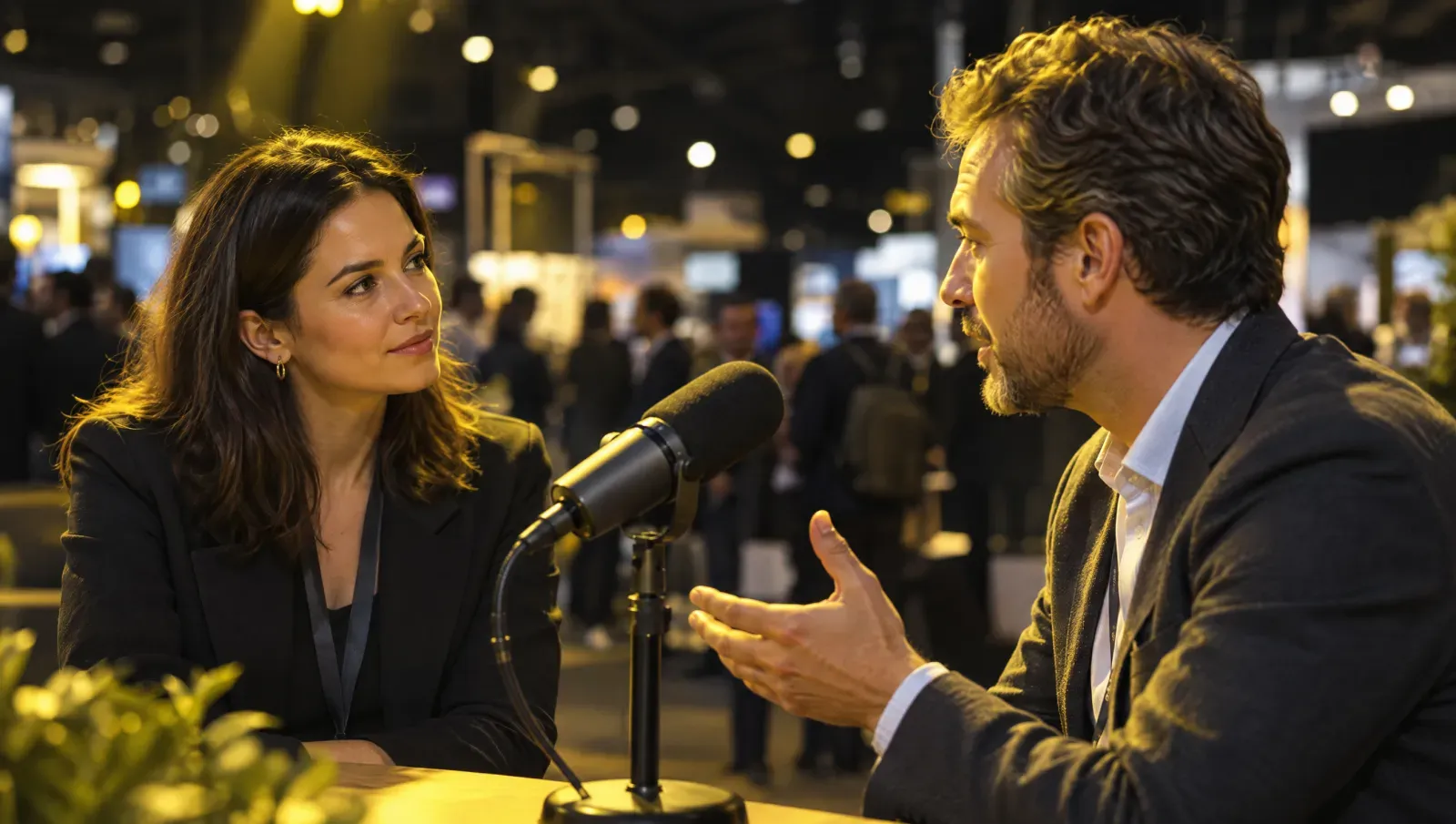
Podcasts and video
Industry podcasts need knowledgeable guests, and transcripts or episode notes end up online with your name and often a link. YouTube, incidentally, is among the domains most cited by Google AI Mode in the Semrush study.
Wikipedia and Wikidata: when it makes sense and how not to get burnt
Wikipedia is among the five domains most cited by ChatGPT in the July-October 2025 Semrush study, but an entry about your company only makes sense if there are already independent, relevant sources that talk about you. Without them, the entry gets deleted and the attempt leaves an unflattering trace.
The rules are clear: the conflict of interest guidelines strongly discourage people who work for the company from editing the entry directly, require every paid edit to be disclosed and point to proposing changes on the talk page, where other users assess them. For most SMEs it’s better to work on awareness first and let the entry come when the conditions are there.
Wikidata is different: it’s a structured database of entities with a lower barrier to entry, and it feeds many systems that recognise companies. Here too, every piece of data needs a verifiable source. An item with the correct name, official website, sector and headquarters helps avoid confusion with companies of the same name.
Reviews, Reddit and LinkedIn: the reputation that writes itself
Reviews and community discussions are frequent sources for comparison questions (“is X or Y better?”, “has anyone tried…?”). You can’t control them; you can only earn them and feed them through honest participation.
- Reviews. A well-kept Google Business Profile, industry platforms (G2 and Capterra for software, category portals for other fields), systematically asking for a review after a successful delivery, prompt replies even to criticism.
- Reddit and forums. Take part as people, with your name and role declared, answering technical questions. Anyone who opens accounts to praise their own products gets found out fast.
- LinkedIn. Semrush’s study of the 89,000 LinkedIn pages cited by AI (325,000 prompts, January-February 2026) finds LinkedIn in 14.3% of ChatGPT search answers and 13.5% of Google AI Mode answers. Articles account for between 50% and 66% of citations, around 95% of the posts cited are original (reshares hardly count) and on ChatGPT and AI Mode personal profiles outweigh company pages.
For a B2B company, that means giving space to your experts’ profiles, with bylined articles that each explain one idea.
Backlinks and AI answers: do links still matter?
Yes, backlinks still matter, but as a means of being found and considered rather than as a score to accumulate. Google AI Overviews and AI Mode start from the search index, and pages that rank well have more chances of being chosen; an editorial link from an authoritative publication helps rankings and brings crawlers to your pages.
What has changed is their relative value: a link from any old site, in an article written specifically to host it, does little; an unlinked mention in a leading publication, next to the right words, can carry more weight in how a model describes your company. To learn how Google chooses its sources in AI Mode, see our article on how to get cited by Google AI Mode, and for the technical side of your website there’s our SEO checklist for AI search.
A 90-day editorial and PR plan
Ninety days are enough to set up the work, produce the first citable content and see the first mentions. They’re not enough to change a brand’s reputation, which moves on longer timescales.
| Period | Goal | Activities | Output |
|---|---|---|---|
| Weeks 1-2 | Understand the starting point | Audit of existing mentions, test 20-50 prompts on ChatGPT, AI Overviews, AI Mode and Perplexity, map the competitors being cited | Baseline snapshot and starting share of voice |
| Weeks 3-4 | Choose topics and experts | Define 2-3 topics the company has the standing to talk about, identify spokespeople, sort out author pages and LinkedIn profiles | Topic plan, expert profiles, author pages online |
| Weeks 5-6 | Build the citable asset | Collect and analyse proprietary data or run a survey, write the report, a dedicated page on the website with method and charts | First report or observatory published |
| Weeks 7-8 | Open relationships | List of 10-15 publications and 5 podcasts, personalised pitches with a preview of the data, contact with the industry association | First pieces published and interviews booked |
| Weeks 9-10 | Distribute | LinkedIn articles by the experts, a short version for the newsletter, a talk at an event or webinar, answers in communities | Multiple appearances on the same topic |
| Weeks 11-12 | Measure and adjust | Repeat the initial prompts, count mentions and links, read branded search and referrals, decide the topic for the next quarter | Comparison report and plan for quarter 2 |
One solid, well-distributed report in a quarter is better than four weak pieces of content.
How to measure digital PR in AI search
AI-oriented digital PR is measured with four families of indicators: brand mentions, presence in AI answers, branded searches and referral traffic. Each has one or more items in the checklist below. None is enough on its own; together they give an honest picture.
Monthly measurement checklist:
- Mentions: number of new mentions of the brand and its experts on third-party sites, with and without links, separating trade publications, associations and communities.
- Impressions in Google’s AI features: Search Console’s generative AI performance report, available for all sites from 31 August 2026, shows which pages appear in AI Overviews and AI Mode. Clicks and queries are missing, but growth after a piece in a trade publication is a good sign.
- Share of voice in AI: across a fixed list of prompts, how often the brand appears compared with competitors. You can do it by hand or with tools such as Ahrefs’ Brand Radar or Semrush’s AI monitoring.
- How you’re described: beyond presence, the content. Do the AIs say accurate things about your company? Do they attribute the right product to the right sector?
- Branded searches: the trend in queries containing the company’s and products’ names in Google Search Console. If PR is working, more people search for you by name.
- Referrals: visits from publications, podcasts, LinkedIn and AI assistants (chatgpt.com, perplexity.ai, gemini.google.com, copilot.microsoft.com) in GA4, with a dedicated channel group.
- Editorial backlinks: new relevant referring domains, judged on quality and topical consistency rather than quantity.
What changes for lead generation and CRM
A lead who has read about you in a publication or in a ChatGPT answer is often further along in their decision. The problem is that they almost always arrive as direct traffic or via a branded search, and in the report they seem to have come from nowhere.
Three steps help you hold on to this value:
- In your contact form, add a free-text field or a “How did you hear about us?” menu, with options such as “article or magazine”, “AI answer (Google, ChatGPT…)”, “event”, “podcast”.
- Record the answer in the CRM as a property of the contact and the opportunity, so you can compare close rates and deal times by origin.
- In quarterly reports, read spikes in mentions, growth in branded searches and new direct leads together. If they move together, the relationship is plausible even without a tracked click.
There’s an advantage for sales too: an authoritative article or a bylined report can be attached to a proposal and shortens the phase in which the customer has to decide whether to trust you.
Mistakes to avoid
- Blanket press releases. Sending the same release to hundreds of addresses, or publishing it on paid distribution sites, produces identical copies that nobody reads. Muck Rack puts paid content at 0.3% of AI citations.
- Bought links. Google’s spam policies treat exchanging money, goods or services for links that pass value as link spam, including advertorials, guest posts and press releases with optimised anchor text. If content is sponsored, the link must be qualified with
rel="sponsored"orrel="nofollow". - Low-quality guest posts. Generic articles on sites that publish anything for a fee, with no readers.
- Measuring only links. Unlinked mentions disappear from the report and a project that’s working looks as if it’s standing still.
- Shortcuts on Wikipedia and in communities. Entries written by the marketing department and improperly solicited reviews get removed and leave a mark on your reputation.
A digital PR and SEO plan built around your sector
If you want to understand how ChatGPT, AI Overviews and Perplexity describe your company today, and which publications, associations and experts could change that story, we start from an analysis of the mentions and prompts in your market. Our SEO and content teams work together: the technical side of the website and the GEO strategy on one side, the editorial plan and relationships with publishers on the other.
You can book a call with us or write to us using the contact form. We’ll tell you frankly whether it makes sense to start now, on which topics, and what to expect in the first three months.
Frequently asked questions
Are unlinked mentions any use?
Yes. According to the Ahrefs study of 75,000 brands, brand mentions across the web are the factor most correlated with appearing in AI Overviews, far more than the number of backlinks. They associate the company’s name with a topic even when there’s no link to follow.
How long does it take to see results in AI answers?
The first pieces in publications and podcasts usually come within the first two or three months of work. For them to be reflected in ChatGPT or AI Overview answers usually takes more months and a consistent presence on the same topics.
Is it worth paying for articles in online publications?
Only if the aim is visibility with those readers and the content is declared as sponsored, with sponsored or nofollow links. As a shortcut to links it goes against Google’s policies, and paid content carries very little weight among the sources AI cites.
Should I create a Wikipedia page for my company?
Only if there are already independent, authoritative sources that cover you in depth. Wikipedia’s rules discourage people who work for the company from editing the entry directly and require paid edits to be disclosed.
How can I tell if ChatGPT cites my brand?
Prepare a fixed list of questions your customers ask before buying and repeat them every month on ChatGPT, AI Overviews, AI Mode and Perplexity, noting who gets cited. For broader monitoring there are dedicated tools, such as Ahrefs’ Brand Radar and Semrush’s AI monitoring.
 FREE GUIDE · 21-PAGE PDFSEO + AI Search 2026: the complete checklist for staying visible on Google and in AI answersA practical guide to making your website, content and brand findable on Google and citable by AI Overview, AI Mode, ChatGPT, Gemini and Perplexity, with ready-made checklists and templates.Read it or download the PDF