





























Account-based marketing for B2B SMEs: when it pays off, how to start and what budget you need
Alessandro Papa16 min read

IN SHORT
Account-based marketing pays off for a B2B SME when there are only a few hundred possible customers, a contract is worth a lot, the cycle lasts months and several people make the decision. You start from a written ICP, a list of 50-300 companies split into three tiers, content by industry and role, LinkedIn Ads on company lists and outreach from the sales team. A 90-day pilot is measured on account coverage, opportunities opened and pipeline.
Topic of our service LinkedIn Ads · industry B2B & Manufacturing
A company that builds wastewater treatment plants for the food industry doesn’t need ten thousand leads. It needs forty factories in Italy and Austria to know who it is, the production manager and the purchasing manager to have heard its name before the next tender, and the salesperson to reach the phone call with something useful to say. That is account-based marketing (ABM): you choose the companies first, then build marketing and sales around them.
The short answer: for a B2B SME, ABM pays off when there are only a few hundred possible customers, a contract is worth tens of thousands of euros or more, the sales cycle lasts months and several people make the decision. You start with a written ICP, a list of 50-300 accounts split by priority, dedicated content, LinkedIn Ads on company lists and a salesperson working the same accounts. A 90-day pilot is within reach of an SME, provided it is measured on pipeline.
What account-based marketing is, in practice
ABM is a way of doing B2B marketing in which the unit of work is the target company: you choose a closed list of accounts and coordinate advertising, content, email and sales activity to turn them into an opportunity. The classic funnel starts wide and filters; ABM starts narrow and works in depth.
For years it was presented as something for large groups. Today almost everything you need is within an SME’s reach: a CRM, LinkedIn’s company targeting, a salesperson who knows the market. What is usually missing is the method that holds the pieces together.
Dreamdata’s 2026 LinkedIn Ads report, based on more than 3.5 million B2B customer journeys, estimates an average buying journey of around 7 months with an average of 10 people involved. With numbers like that, convincing the single contact who downloaded a PDF achieves little. We covered this in our article on the B2B customer journey.
When ABM is right for an SME (and when it isn’t)
ABM pays off when the market is small and identifiable, the value per customer is high and the sale is complex; it doesn’t suit companies selling to thousands of businesses with small orders and quick decisions. This is the table we use on the first call.
| Signal | ABM makes sense | A volume approach is better |
|---|---|---|
| Possible customers | From a few dozen to a few hundred, you can name them | Tens of thousands, hard to tell apart |
| Value of a customer | Tens or hundreds of thousands of euros | A few thousand euros |
| Sales cycle | From 3 months to over a year | Days or weeks |
| People who decide | 3 or more (technical, purchasing, management) | One or two |
| Role of the salesperson | Central, with direct relationships | Marginal |
If at least four rows out of five fall on the left, it’s worth a try. Otherwise the money works harder on Google Ads, SEO and classic lead generation.
In industrial marketing there is often a middle way: lots of small customers and a few large groups that account for half of turnover. There you run ABM only on the top tier and inbound demand covers the rest.
How to define the ICP for ABM
The Ideal Customer Profile (ICP) is the written description of the kind of company that buys from you, profits from it and stays: you derive it from the best customers you already have. Without an ICP shared by marketing and sales, the account list turns into everyone’s wish list.
Take your 10-20 best customers of the last three years (by margin, length of relationship, ease of management) and look for what they have in common: industry and ATECO code (the Italian business activity classification), turnover and headcount, the area your after-sales service can cover, technologies or certifications in place, timing signals such as a new plant, a change of ownership or a regulation that forces them to invest.
Alongside the ICP you need a map of the roles. In an engineering company buying planning software, for example, the production manager uses the product, IT assesses the integration, the controller looks at the return and the owner signs. Each of them needs a different message.
How to build the account list: tier 1, 2 and 3
The list is built by cross-referencing the ICP with concrete sources (CRM, LinkedIn Sales Navigator, trade fairs, Chamber of Commerce data) and split into three priority levels with different degrees of personalisation. For an SME, a starting list of between 50 and 300 companies is manageable.
The sources, in order of reliability:
- CRM: customers to expand, lost customers, deals that ended badly, trade fair contacts never followed up.
- LinkedIn Sales Navigator: filters by industry, size and area, and a map of who holds which role in the target company.
- Exhibitor catalogues from industry trade fairs: companies that are active and willing to invest.
- Chamber of Commerce data and company databases: turnover, headcount, ATECO code and operating sites to filter and rank.
| Tier | How many | Who goes in | Personalisation |
|---|---|---|---|
| Tier 1 | 10-30 | Very high potential, already known to sales | Messages for the individual company, direct contact, visits |
| Tier 2 | 30-100 | Squarely in the ICP, few active relationships | Content by industry, dedicated sequences, ads by cluster |
| Tier 3 | 100-300 | In the ICP, little is known about them | Industry campaigns, nurturing, promotion to tier 2 on signals |
Every month you look at the signals (website visits, interactions with campaigns, replies to the salesperson) and promote or demote accounts. It’s the logic of B2B lead scoring, applied to the company instead of the person.

What content each tier needs
Tailor-made material for tier 1, content by industry or problem for tier 2, category content for tier 3: the goal is to give each role within the account a concrete reason to stop. An SME is better off producing a few modules and adapting them.
- One pillar piece per industry (technical guide, comparison of solutions) from which to draw posts, creatives and emails.
- One application case per industry, anonymous if need be, with a problem similar to the account’s.
- A one-pager per role: specifications and reliability for the engineer, total cost and lead times for purchasing, risk and return for management.
- For tier 1, a short analysis of the company, an offer of a site survey or an invitation to visit your premises.
Take a company selling machine vision systems: it chooses three clusters (food packaging, automotive, pharmaceuticals) and for each one prepares a guide to typical defects, a few creatives and an email sequence. For the twelve tier 1 accounts, the salesperson writes a one-page note on the production lines visible in public videos and photos.
How to use LinkedIn Ads for ABM
LinkedIn is the advertising channel best suited to ABM because it lets you upload a list of companies and show ads only to the people who work there, filtered by job function and seniority. Before building the list, it’s worth knowing the technical requirements.
According to LinkedIn’s documentation on company lists in Campaign Manager:
- the list is uploaded as a CSV from the Campaign Manager template, with at least 300 rows and at most 300,000 companies (or 20 MB);
- LinkedIn recommends 1,000 companies or more, with website and LinkedIn page URL to improve matching;
- the audience must have at least 300 members for the campaign to run, and matching can take up to 48 hours.
So for an SME with 40 tier 1 accounts, the tier 1 list on its own can’t be uploaded: you upload a single file with all three tiers and segment by function and seniority, or you enter the company names directly in the targeting, checking that the audience exceeds 300 members. LinkedIn’s guidance on audience size suggests much larger audiences for volume campaigns; in ABM you accept a small audience and keep an eye on frequency.
The formats we use most often in an ABM programme for SMEs are single images and short videos to build name recognition, document ads so people can flick through a guide in the feed, and Thought Leader Ads, that is sponsored posts by the owner or technical director, which put one person in front of another. Lead Gen forms make sense when the account is already warm.
On sponsored messages (Message Ads and Conversation Ads), LinkedIn’s guide to Sponsored Messaging, consulted in October 2026, states that in the European Economic Area and Switzerland they are delivered only to people who have consented to receive them in their inbox: on an Italian audience that is already narrow, real reach is much lower than estimated.
To read the effect on accounts there is the Companies section of Campaign Manager (Companies Hub, in the Plan menu), which shows engagement by company, paid and organic, and lets you save the most active companies as a new list. The rest of the setup is in our guide to LinkedIn Ads for B2B.
Email and sales outreach: who does what
Advertising prepares the ground, the salesperson opens the conversation: a personal email, a phone call and a message from their LinkedIn profile go out when the account has already seen the name several times. Marketing provides signals and materials, sales chooses the moment.
For a tier 2 account a sequence lasts 4-6 weeks: connecting with two or three people at the account, a relevant comment on one of their posts, a short email with an industry resource, then the phone call. If the message could go to any company, it isn’t ABM.
On the rules: in Italy promotional emails normally require prior consent (Article 130 of the Italian Privacy Code), even towards professionals with a named business address. Bought lists and mass cold sends are out; individual contact on a topic relevant to the person’s role should be assessed with whoever handles privacy in the company.
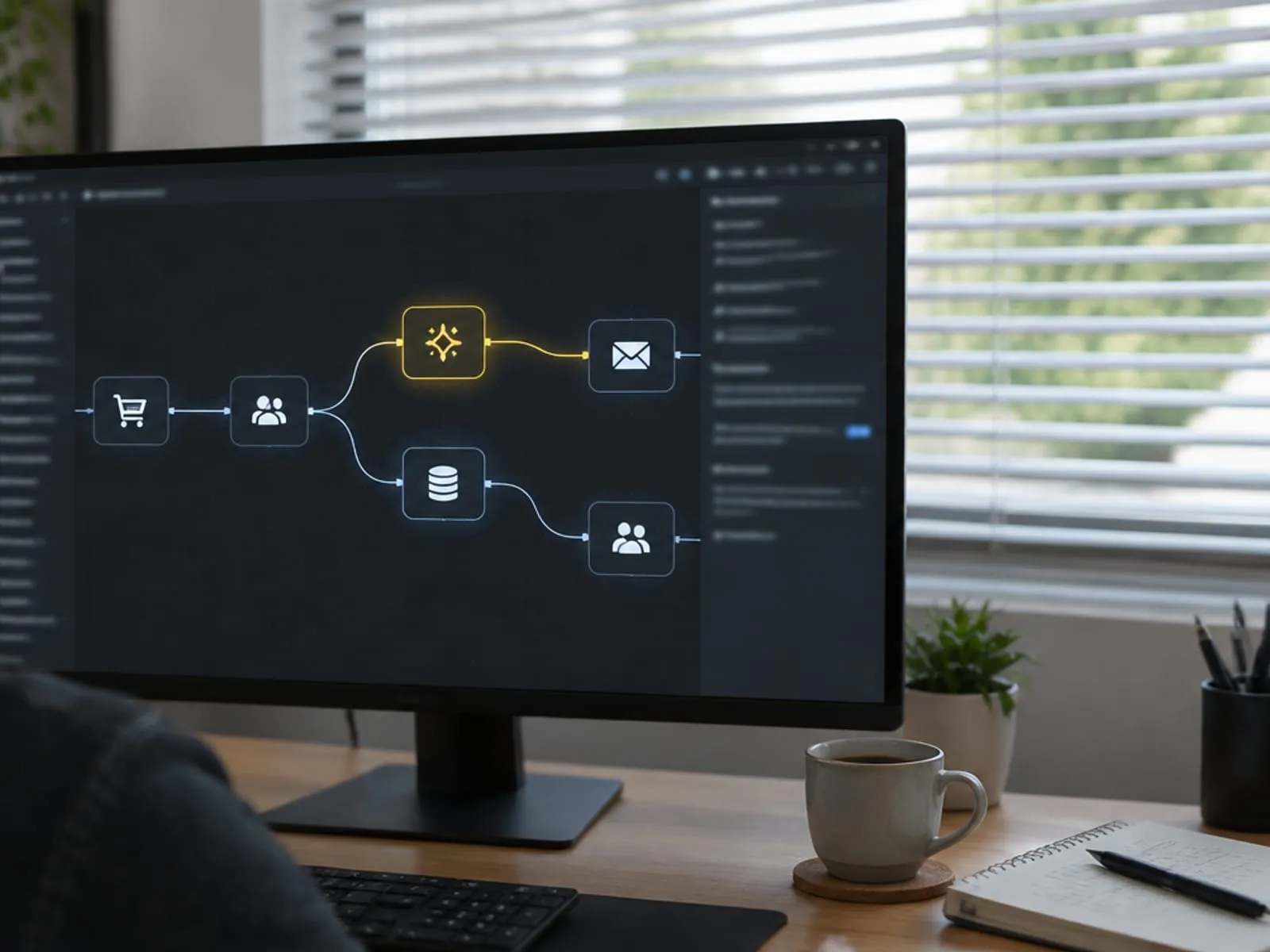
Anyone who downloads a piece of content or fills in a form enters a marketing automation journey for their industry, and the salesperson gets an alert in the CRM.
How marketing and sales work together
You need a written agreement on which accounts are being worked, who does what and when an account changes hands; without one, ABM shrinks to a LinkedIn campaign that costs more than usual.
- A single list in the CRM, with a tier field and a sales owner for each account.
- Shared handover signals, for example three people from the same account interacting within 30 days, or a visit to the contact page.
- Thirty minutes every two weeks between whoever runs the campaigns and whoever sells, on the accounts that have moved.
- Every contact logged in the CRM, otherwise at the end of the pilot nobody knows what worked.
The next step is linking marketing activity to signed contracts: we cover it in from lead to contract, connecting CRM and revenue.
Which KPIs to use to measure ABM
ABM is measured on accounts: how many have been reached, how many are engaging, how many have an open opportunity and how much pipeline they generate. Clicks, CTR and cost per lead say little, because the audience is deliberately small and expensive.
| KPI | What it measures | Where to read it | From when |
|---|---|---|---|
| Account coverage | Accounts on the list reached by ads or contacts | Campaign Manager, CRM | First month |
| Role coverage | Accounts with at least 2-3 roles reached | CRM, Sales Navigator | First month |
| Engagement per account | Accounts with repeated interactions on ads, website, email | Campaign Manager, analytics, CRM | Second month |
| Meetings booked | Accounts with a call or visit in the diary | CRM | Second month |
| Opportunities and pipeline | Open opportunities and their value on target accounts | CRM | Third month |
The most useful comparison is with a control group: companies in the ICP that are not on the list. If the target accounts open more opportunities or close sooner, the programme is working. For campaign data we use RunAlytics, which brings LinkedIn, Google Ads and Meta together in a single dashboard; the pipeline stays in the CRM.
What budget ABM needs in an SME
A 90-day ABM pilot for an Italian SME mostly requires internal time and content; LinkedIn spend matters, but it is rarely the biggest item. The orders of magnitude depend on the number of accounts, markets and materials already available.
Two public reference points. LinkedIn sets a minimum daily budget of 10 dollars per campaign and a minimum total budget of 100 dollars for a new campaign. The Dreamdata report gives an average CPC on LinkedIn of 5.98 euros; with very narrow ABM audiences the cost per click tends to rise, so take it as a baseline.
The example below rests on explicit assumptions and is not a quote: around 300 accounts (20 tier 1, 80 tier 2, 200 tier 3), one market, two or three industry clusters, a salesperson partly dedicated to it.
| Item | What it includes | Order of magnitude (90 days) | Assumptions |
|---|---|---|---|
| Marketing time | ICP, list, coordination, reporting | 4-8 hours a week | Internal lead, possible external support |
| Sales time | Tier 1 research, outreach, CRM | 3-6 hours a week | Salesperson who also handles other customers |
| Content | 2-3 pillars, 10-15 creatives, one-pagers, 1-2 cases | €2,500-8,000 with external support | Some technical material already exists |
| LinkedIn media | Company lists, retargeting, Thought Leader Ads | €50-130 a day, roughly €4,500-12,000 | Audience of a few thousand people |
| Tools | Sales Navigator, CRM, email | According to current price lists | CRM already in place, 1-2 Sales Navigator licences |
If you already have a tidy CRM and good technical materials, you’ll sit at the lower end of the ranges. To fit the pilot into the annual plan, the logic of our guide to the B2B marketing budget applies: first decide how much pipeline you need, then how much to invest to generate it.
Checklist for a 90-day pilot
Four weeks of preparation and eight of measured activity. This is the order we follow.
- Write the ICP from your 10-20 best customers and get marketing and sales to sign it off.
- Map the decision-making roles and what each one cares about.
- Build the list and split it into tiers; load it into the CRM with an owner for each account.
- Prepare the CSV for LinkedIn (at least 300 rows, with website and LinkedIn page) and check that the audience exceeds 300 members.
- Produce one pillar piece per cluster and the creatives derived from it.
- Set up the LinkedIn tag, conversion events and ABM fields in the CRM.
- Start awareness on the accounts, then retargeting; from the second month, outreach to the accounts showing signals.
- On day 90, compare coverage, engagement, meetings and pipeline against the control group.
Mistakes to avoid with account-based marketing
Almost all of them come from treating ABM as an advertising campaign rather than a programme shared with sales.
- A list chosen by marketing alone: if the salesperson doesn’t recognise the accounts as theirs, they won’t work them.
- A list that’s too big: a thousand companies with the same message is an industry campaign with ABM costs.
- Measuring cost per lead on an audience of a few thousand people.
- A single contact per account: the purchasing department comes to the table without knowing who you are.
- An out-of-date CRM: at the end of the pilot nobody can tell what produced the opportunities.
What changes for lead generation, CRM and performance
With ABM, lead generation shifts from the number of contacts to the quality of the accounts in the pipeline, the CRM becomes the centre of the programme and the metrics move from the campaign to the company.
A “target account” field on the company record is enough for the CRM to give their forms a different priority. The salesperson gets fewer leads, with more context: ads seen, pages visited, content downloaded. Platform metrics are for optimising campaigns; account and pipeline metrics are for deciding whether to carry on. It’s also the moment to sort out your first-party data: ABM built on a messy CRM produces reports nobody uses.
Want to find out whether ABM is right for your company?
Before the campaigns, it’s worth checking whether the market lends itself to it, how many target accounts you have and whether sales has the time to follow them. That’s the first phase of our ABM consultancy, which then continues with LinkedIn Ads campaigns: together we define the ICP and the account list, estimate the audience on LinkedIn and tell you frankly whether a pilot makes sense or whether the budget will work harder on other channels.
You can book a call with Federico or write to us via the contact form, telling us your market, typical customers and the average value of a contract. We’ll get back to you with our view.
Frequently asked questions
Does account-based marketing work for a small company too?
Yes, if it sells to a few high-value customers with complex decisions. You need 50-300 target accounts, a CRM and an available salesperson; dedicated ABM platforms aren’t needed to get started.
How many accounts do you need to do ABM on LinkedIn?
To upload a company list, LinkedIn requires at least 300 rows and an audience of at least 300 members. If you have fewer key accounts, you upload them together with tiers 2 and 3 or enter them in company targeting, as long as the audience exceeds the threshold.
How long does it take to see results from ABM?
Coverage and engagement can be read from the first month, meetings and opportunities usually from the second or third. Contracts follow the length of the sales cycle, which in industrial B2B often runs to several months.
What’s the difference between ABM and lead generation?
Lead generation starts from a broad audience and filters out the interested contacts; ABM starts from a closed list of companies and works on several people within each one. They often coexist.
Can you send cold emails to target accounts?
In Italy, promotional emails normally require prior consent even to named business addresses, so no mass sends to bought lists. Individual contact by the salesperson should be assessed with whoever manages privacy.
 FREE GUIDE · 25-PAGE PDFMarketing automation for SMEs and B2B: the 7 workflows you should already have runningSeven workflows to design with triggers, timings, content and KPIs, turning every contact into a measurable journey from the first form through to sales and reactivation.Read it or download the PDF