
























Artificial intelligence for SMEs: 7 ways to use Claude in your business
Milica Subotic11 min read

IN SHORT
A practical guide to how an Italian SME can use Claude today: writing content, mockups without a designer using Claude Design, an assistant with project memory (Claude Cowork), process automation with n8n, data analysis, customer care and the staff training required by the AI Act. Seven real use cases, not theory.
Topic of our service AI Solutions
Three years ago, talking about artificial intelligence for SMEs almost always meant talking about a project that had been put off: big-company costs, skills nobody in-house had, a return on investment that was hard to prove to the owner. Today things are different. With a 20-dollar-a-month subscription and a model such as Anthropic’s Claude, a small Italian business can write content, build mockups, automate processes and train its team, without hiring anyone and without a dedicated IT department.
This article is a practical guide to artificial intelligence for SMEs, applied to Claude: seven concrete use cases, taken from what is already happening in Italian companies of 5, 20 or 100 people. No theory, no hype: tools, workflows and limitations to know about before you start.
We’re not talking about a single miracle product. We’re talking about a set of features, some free and some paid, which together cover much of what a small business produces every week: copy, images, analysis, replies to customers, repetitive processes. AI for SMEs works best when you treat it as a drawer of tools to open one at a time, not as a switch to flick on and forget.
Why artificial intelligence for SMEs pays off right now
The reason AI for SMEs has become a practical matter rather than just a conference title is simple: the barrier to entry has come down. You no longer need a data scientist to use a model like Claude; you need to be able to write a clear instruction and know what you want to achieve.
Anyone looking into Claude for business today will find a tool that runs in the browser, with nothing to install, a free plan to get started and paid plans that start at prices even a company with a handful of employees can manage. The question is no longer “can we afford it?” but “where do we start?”: that’s the question that really moves AI for SMEs from a conference title to the desks of the people who work every day.
The seven applications below are the cases where AI for SMEs produces a measurable return in weeks, not months. You don’t need a six-figure budget or an in-house IT department: you need a paid plan (or even just the free one, to start with), a clear process to improve and a willingness to review every output before using it with real customers.
1. Content marketing and SEO without a dedicated editorial team
The most immediate use of AI for SMEs is still content production. A company without an in-house copywriter can use Claude to write blog articles, product descriptions, social posts and newsletters, as long as the brief is as precise as the one you’d give a real colleague.
The quality of the output depends on the quality of the instruction. If you don’t yet know how to build an effective prompt, what makes Claude different from other models is a good starting point: role, context, task and constraints are the elements that turn a generic output into copy you can publish with a few edits.
For SEO, this means being able to cover more keywords, more formats and more channels without growing the team. This is where AI for SMEs stops being an experiment and becomes a production multiplier, provided there’s always human review before publication.
An agency or in-house marketing team that loads its editorial guidelines, three or four reference articles and its target keywords into a project gets drafts that are already consistent with the brand’s tone. Human work shifts from writing from scratch to targeted review, and it’s precisely this shift that makes AI for SMEs sustainable across large volumes of content.
2. Mockups, landing pages and visual briefs without a designer
Anyone in marketing knows the bottleneck: you have an idea for a landing page or an email campaign, but you need the designer to make it visible, and the designer’s diary is full for the next two weeks.
Claude Design changes that step, and it’s probably the easiest application of AI for SMEs to show a sceptical colleague. It’s a tool worth exploring as a whole for anyone handling marketing in an SME: describe the landing page, email layout or pitch deck you need, get a first version in a few minutes and refine it with follow-up instructions in plain language, without touching a single layer by hand.
For AI for SMEs applied to visuals, the value isn’t replacing the designer. It’s arriving at the brief with something concrete already in hand, rather than a text document someone else has to translate into images. Files can be exported to PDF, PowerPoint or HTML, and in most cases that’s enough to get aligned with a client or colleague before moving on to the final version.
3. A colleague who remembers your company’s context
One of the limitations of generic chatbots, and one of the reasons AI for SMEs gets abandoned after the first attempts, is that they forget everything with each new conversation. You explain your brand, your tone, your products, and at the next session you start from scratch.
Claude Cowork solves exactly that. It lets you set Claude up as a company assistant with persistent memory of brand guidelines, product files and recurring instructions, so every conversation starts with the right context already in place. For an SME handling marketing, sales and support with a small team, that means less setup time for each request and outputs closer to what’s really needed, right from the first attempt.
This is probably the point where AI for SMEs stops feeling like a tool and starts behaving like a real colleague: one who doesn’t forget the instructions given the week before. An agency looking after ten clients can keep a project for each, with campaign history and target keywords always to hand, instead of starting from zero with every brief.
4. Automating processes across CRM, email and lead management
AI for SMEs isn’t just about writing. It’s also about the processes that are done by hand today: copying a contact from the form to the CRM, sending the welcome email, assigning the lead to the right salesperson.
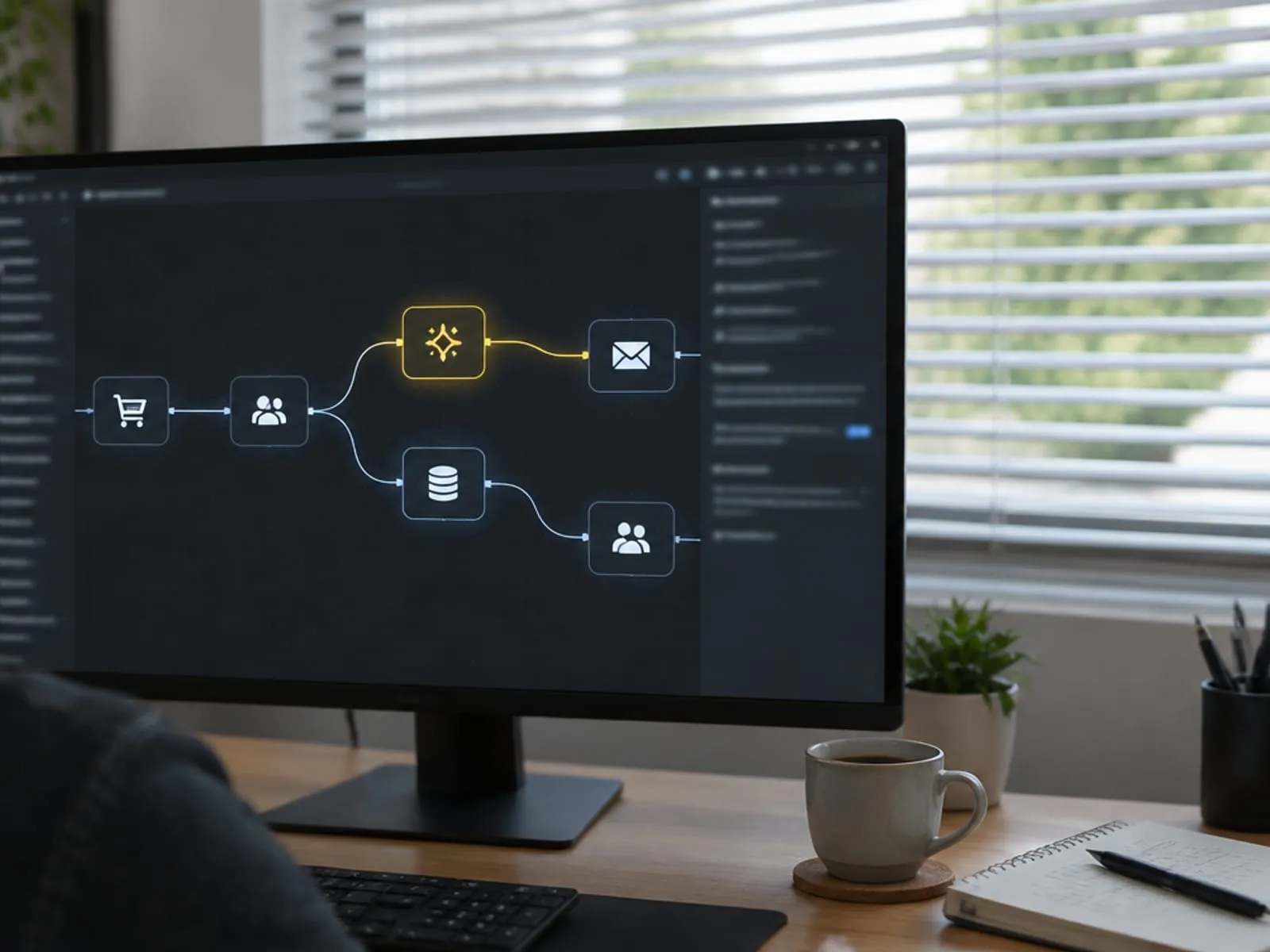
By connecting Claude to a workflow automation platform, you can integrate Claude into n8n flows that handle the entire lead journey: from form submission to automatic qualification, from notifying the salesperson to the first personalised reply email, generated by the model from the contact’s data.
For a small business that currently loses an hour a day to Excel spreadsheets and manual steps, this application of AI for SMEs is worth the time spent on the initial setup on its own. The whole flow, from the form to the first reply email, can take less than thirty seconds with no human intervention, and the salesperson is only notified when the lead is already qualified.
5. Data analysis and reporting nobody in the company has time for
Many SMEs have data nobody really looks at: sales files, Google Analytics reports, exports from the management system that sit closed in a folder. Claude can read a CSV or a spreadsheet and return an analysis in plain language, without complex formulas or a dedicated analyst.
It isn’t just about calculations. The model spots anomalies in the numbers, explains trends and suggests hypotheses about what caused them. For anyone who has to prepare a monthly presentation for the owner or a brief for the sales team, this use of AI for SMEs turns hours of manual work into a conversation lasting a few minutes.
A concrete example: you upload the sales export for the last quarter and ask which products are losing margin and why. Within minutes you have a first hypothesis to check, not a sheet full of numbers to interpret on your own. Applied to reporting, AI for SMEs shortens the time between “we have the data” and “we know what to do”.
6. Customer care and first replies to customers
A customer who writes at 10 pm and gets a reply the next day is a customer who has already looked at your competitor in the meantime. For an SME with a small support team, covering every time slot with people alone is almost impossible, and it’s one of the areas where AI for SMEs shows the most immediate return.
AI for SMEs comes in here through chatbots trained on company content, which answer recurring questions, qualify the contact and pass to human colleagues only the cases that really need handling by hand. AI solutions designed for customer care work exactly like this: they cut response times on simple requests and leave the team the conversations that call for judgement.
A chatbot is trained on content that already exists, such as website pages, FAQs or the product catalogue, and is up and running within minutes. It doesn’t replace human support for complex cases, but it covers the hours and volumes that currently go unanswered, and it’s one of the quickest ways for a small company to put AI for SMEs to the test without overturning existing processes.
7. Team training and compliance with the AI Act
The last use case for AI for SMEs isn’t about what Claude produces, but about what your team can do with it. Since 2 February 2025, Article 4 of the EU AI Act has required every organisation using artificial intelligence systems to ensure an adequate level of AI literacy among its staff. It’s no longer just good practice: it’s a legal obligation, and it applies to SMEs too.
Introducing AI for SMEs without training the people who’ll use it every day means leaving most of the value on the table, and in some cases not being compliant. To find out exactly what the AI training obligation involves and how to structure documented learning paths for staff, it’s worth spending time on this before scaling up the use of the tools across the company.
A well-designed training programme isn’t just a box-ticking exercise: it’s the difference between a team that uses AI for SMEs occasionally and one that genuinely builds it into everyday workflows, with records, tests and certificates kept on file in case of an inspection.
Where an SME that wants to start should begin
People coming to Claude for the first time, or exploring AI for their small business, often make the same mistake: they try to apply it to everything at once. The opposite approach works better. Choose one process that currently takes repeated manual time, whether that’s writing content, replying to customers or managing leads, and start there.
AI for SMEs isn’t a technology you adopt with one click. It’s a change of process that needs designing, measuring and correcting in the first few weeks. People who use Claude for a company’s day-to-day work, and not just for one-off questions, get different results from those who use it occasionally.
If you want to understand which of your company’s processes have the most to gain from AI and where it makes sense to start in your specific case, the quickest way is to talk to people who do it every day for clients in different industries: you can book a 30-minute call with the Digital Runner team.
FAQ
What does Claude actually do for a small business?
Claude is Anthropic’s artificial intelligence model. For an SME, the most practical use cases are writing content, creating mockups and visual briefs with Claude Design, ongoing assistance through Claude Cowork, process automation with tools such as n8n, data analysis and customer care support.
How much does it cost to introduce artificial intelligence in an SME?
Basic access to Claude is free, with usage limits. Paid plans start at 20 dollars a month per user and include more powerful models, project memory and larger context windows. The real cost depends on how many processes you want to automate and how much setup is needed at the start.
Do you need technical staff to use Claude in your business?
No. Claude’s interface requires no programming skills. For more structured projects, such as integration with CRM and email marketing via API, the support of a technical partner is useful, but everyday use is within reach of anyone working in marketing, sales or customer support.
Does artificial intelligence replace staff in SMEs?
No. It frees up time from repetitive tasks, but decisions, strategy and customer relationships remain human work. Generated content and analysis must always be reviewed by a person before being used.
Where should an SME start with artificial intelligence?
With the process that currently takes up the most repetitive manual time: writing content, managing leads or replying to customers are the most common starting points. It’s better to automate one process at a time and validate it before expanding to others.
What are the risks of artificial intelligence for SMEs?
The main risk is publishing or using unverified output: copy with inaccurate information, automatic replies in the wrong tone, misinterpreted data. The second risk, less visible but regulatory, is not training staff as required by the AI Act. Both are managed with constant human review and a structured training programme for the people who use the tools every day.
 FREE GUIDE · 20-PAGE PDFAI for marketing: 20 practical workflows for marketing and sales teamsA practical playbook for bringing artificial intelligence into everyday marketing and sales processes, while keeping control of data, quality and results.Read it or download the PDF