































We built Runmaniac, the running race portal: why and how it works
Alessandro Papa9 min read
IN SHORT
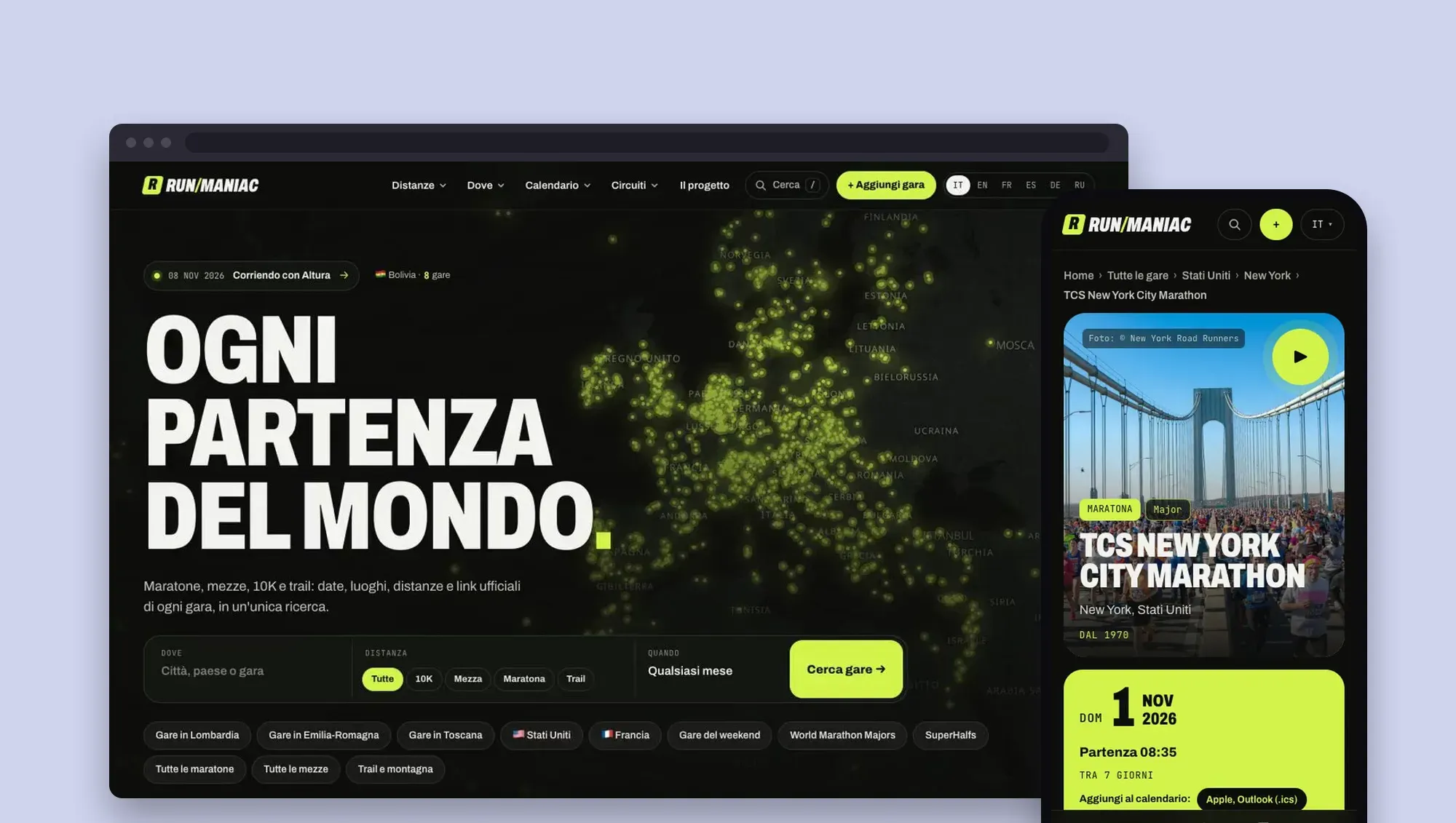
Runmaniac is the running race portal we designed and built from scratch. It brings together marathons, halves, 10Ks and trail races from all over the world, with dates, locations, distances, fees and official links taken from each organiser's website. On 25 October 2026 it lists 17,788 upcoming races in 173 countries. You can search by typing a sentence, there is a guided search in four questions, race pages in six languages, and it is free: it sells no race entries.
Topic of our service Development and integrations · industry Running and events
A Tuesday evening, after training. You have decided to run a half marathon in the spring, maybe not too far from home, maybe in a city you do not know. You open a race calendar and find three interesting names. For each one you open the organiser’s website, look for the date, then the fee, then find out that the rules are a PDF and that entries go through yet another platform. Half an hour later you have a row of open tabs and you still have not decided anything.
The short answer: to save that half hour we built Runmaniac, the running race portal. It puts marathons, halves, 10Ks and trail races from all over the world in one place, with dates, locations, distances, fees and official links taken from each organiser’s website. On 25 October 2026 it lists 17,788 upcoming races in 173 countries. It is free and sells no race entries: it is a service for runners. We designed and built it ourselves, from scratch, and we also present it on the Runmaniac page.
Why did a marketing agency build a portal for runners?
Because running is a world we know from the inside. We work with race organisers and running clubs, and we do marketing for running events. We see the problem of choosing a race from both sides: runners struggle to find the information, organisers struggle to get it seen.
To enter a race you have to jump between calendars, organisers’ websites, PDF rules and entry platforms. Calendars tell you that a race exists; to decide whether to enter you need the date, the fee, the deadlines and the rules, and those are on the organiser’s website. So we decided to do what we do for clients, but for ourselves: a product built on a real problem, with data kept in order and pages built to be found.
What can you find on Runmaniac today?
These are the figures on the runmaniac.com home page on 25 October 2026. They count races from today onwards, so they change every day: new races come in, races already run drop out.
| What | How many |
|---|---|
| Upcoming races | 17,788 |
| Countries | 173 |
| Race photos | 15,146 |
| GPX tracks | 137 |
| 10K races | 4,727 |
| Half marathons | 3,903 |
| Marathons | 1,586 |
| Trail and mountain races | 5,364 |
There are also shorter distances, like the 5K, and longer ones, ultramarathons and ultra trails. The countries with the most races are the United States, France and Italy; in Italy you can also search region by region.
Where does the race data come from?
From the organiser’s official website and the race rules. That is the rule the whole portal is built on: calendars and aggregators are only used to discover that a race exists, then dates, fees, times and rules are looked up at the source. Every detail keeps its source, so you can always trace it back to the document it came from.
Then there is a rule about dates, which is what runners care about most. When the organiser has not yet confirmed the date of the next edition, the race page says so. Confirmed dates are only the ones written on the source. It sounds like a detail, but it is the difference between booking a trip for the right date and finding out at the last minute that the race has moved by a week.
The portal says it at the bottom of every page too: before entering, it is always worth checking dates and fees on the race’s official website. Runmaniac helps you choose; you enter through the organiser.
How do you search for a race?
In the most natural way possible. In the search box you can type a sentence, for example “half marathon near Milan in March”, and Runmaniac turns it into filters: the distance, the place with a radius around it, and the month. Sentences work in all six of the portal’s languages.
Then there are the filters themselves:
- distance, from 5K to ultra trails;
- dates and month;
- country and, for Italy, region;
- maximum fee;
- flat course, open entries, World Marathon Majors and SuperHalfs;
- near me, with a radius, or the area of the map you are looking at.
If you would rather browse, there are ready-made calendars: this weekend’s races, the month-by-month calendar, the year’s marathons, halves, 10Ks and trail races, and the big series such as the World Marathon Majors, the SuperHalfs and the UTMB World Series.
Find your race in four questions
For anyone who does not know where to start there is a guided search. Four questions, one per screen: where you want to run, when, how far, and whether you are after a big event or a small race. Every question can be skipped with “Any”. At the end the portal shows your choices and the races that match all of them, and if there are only a few it also suggests the ones you find by widening the search.
What is on a race page?
Everything you need to decide, on a single page. Take the TCS New York City Marathon page, a race held on 1 November 2026: at the top, the date, start time, distance and a button to add the race to your calendar (Apple, Outlook or Google). Then, scrolling down:
- at a glance: location, start, finish, organiser, official website;
- entry fees, with price tiers and deadlines;
- what is included and rules and requirements, such as the medical certificate or the memberships required;
- where it is, with the start and finish map;
- course, with the GPX to download when there is a track;
- weather: the average race-day weather in past years and, as the date gets closer, the forecast;
- photos, frequently asked questions and similar races.
Across the portal there are more than 15,000 race photos and 137 GPX tracks.
Why six languages?
Because runners travel. A marathon abroad is often chosen months in advance, and reading the fee and the rules in your own language makes everything easier. Runmaniac has race pages in Italian, English, French, Spanish, German and Russian, with the same addresses in every language (only the code changes: /it, /en, /fr…). Race names, on the other hand, are never translated: the Berlin-Marathon stays the Berlin-Marathon in the English version too.
Why is Runmaniac free?
Because it sells nothing: no race entries, nothing to buy. Every race page links to the organiser’s official website and entry page: the portal is there to help you choose well, then you enter directly.
If you want to stay up to date you can sign up for the newsletter from the portal’s home page: it arrives once a month, with the new races.
What about race organisers?
Organisers have an area of their own, Add your race. It is free and you sign in with your organisation’s email. From there you keep your race pages up to date and add new ones: GPX track, times, fees and deadlines, entry links, aid stations and services, photos and videos. Pages completed by the organiser get the “Verified by the organiser” mark.
For organisers it is one more way to be found by runners planning their season. It is the same point we make when we explain when to start promoting a running race: runners choose their race months in advance, and at that moment the information has to be there, complete and correct.
What does Runmaniac have to do with the work we do for clients?
A lot. Runmaniac brings together, in a project of our own, almost everything we do for companies:
- bespoke development: a portal built with Next.js, with filtered search, guided search, maps and a reserved area for organisers. That is the work of our development and integrations service;
- data kept in order: thousands of races collected from official sources, with the source next to every detail and unconfirmed dates flagged as such;
- multilingual websites: six languages with the same addresses, as in our websites and e-commerce projects;
- pages built to be found: calendars by distance, month, country and region, in other words pages that answer what runners really search for. That is the work we do with SEO and GEO.
Building it for ourselves let us test everything in the field, with real data and in production.
Want to build a portal like Runmaniac?
If you have an idea that needs well-collected data, maps, several languages or a search that understands what people type, we can help you build it: from analysing the problem to the code, all the way to the pages that get it found on Google and by AI tools. Everything we did is on the Runmaniac page, and you can try the portal at runmaniac.com.
You can book a call with Federico or write to us through the contact form.
Frequently asked questions
Is Runmaniac free?
Yes. It sells no race entries and there is nothing to buy: it is a service for runners. To enter a race you go to the organiser’s official website, linked on every race page.
Where does the race data come from?
From the organiser’s official website and the race rules. Calendars and aggregators are only used to discover that a race exists; every detail keeps its source and, if the date is not confirmed yet, the race page says so.
Which races are listed?
Marathons, half marathons, 10Ks, trail races and other distances, from 5K to ultra trails, in Italy and the rest of the world. On 25 October 2026 there are 17,788 upcoming races in 173 countries.
Which languages can you use it in?
Six: Italian, English, French, Spanish, German and Russian. The addresses are the same in every language and race names are not translated.
How do you add a race?
From the organisers’ area, “Add your race”: it is free and you sign in with your organisation’s email. From there you update existing race pages and create new ones.
Who built Runmaniac?
Digital Runner, the digital marketing agency based in Turin: we designed and developed it from scratch, and we look after it ourselves.