





























Email marketing automation: what it is, which flows work and how to choose the tools
Milica Suboticupdated on 8 min read

IN SHORT
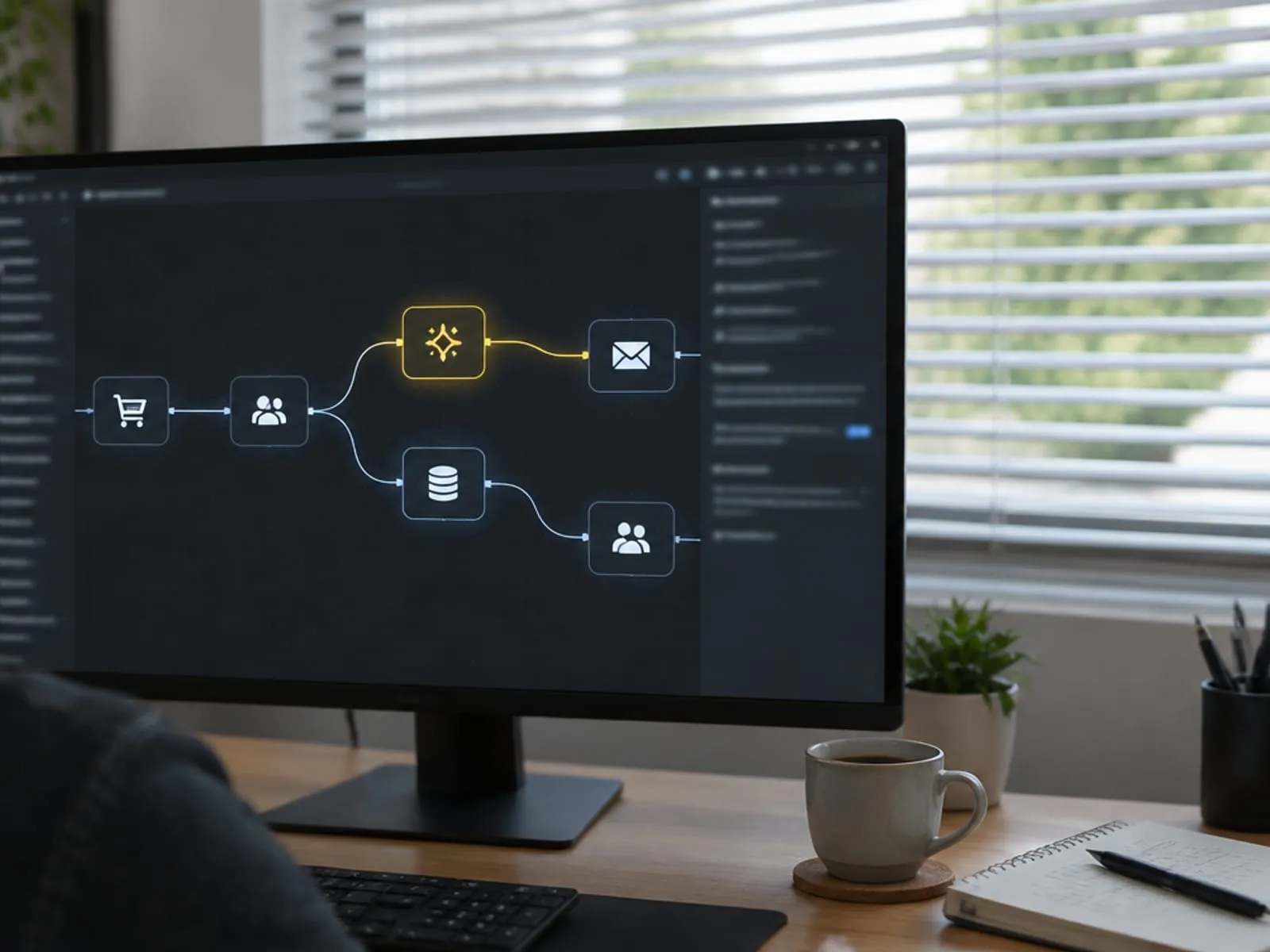
Email marketing automation sends messages automatically when a contact takes an action: signing up, abandoning a basket, visiting a page. In 2024 automated emails generated 37% of email sales while making up just 2% of the volume sent. Here we look at the flows that work (welcome series, abandoned baskets, behavioural triggers), where AI helps, how to choose the tools and why authenticating your domain with SPF, DKIM and DMARC is a prerequisite.
Topic of our service Email Marketing Automation · industry B2B & Manufacturing
In 2024 automated emails generated 37% of all email sales, while accounting for only 2% of the total volume sent. Each automated email brings in, on average, 16 times more revenue than a manual campaign. If your email marketing automation strategy is stuck in 2021, you’re leaving results on the table, not because the channel has changed but because recipients’ expectations have.
In this article we explain what email marketing automation is, which flows still deliver results, what has become obsolete and how to choose the tools. If instead you’re looking for someone to design and run the flows for your company, you’ll find our approach on our email marketing automation service page.
What email marketing automation is and what has changed
Email marketing automation is the automatic sending of emails in response to an event: a sign-up, a purchase, an abandoned basket, a page visit. It’s nothing new, but the context has changed: average open rates have been above 30% for the fifth year running, the channel’s average ROI stands at between 36 and 42 dollars for every dollar spent (Litmus, 2025), and regulatory pressure on deliverability has redrawn the basic technical rules.
What has changed isn’t the logic of automated email flows as such, but the minimum acceptable level of quality. Mailbox providers (Gmail, Apple Mail, Outlook) have raised the bar: they now penalise anyone who hasn’t authenticated their domain properly, who sends to lists that haven’t been cleaned, or who uses misleading subject lines. The good news is that those who do things properly are rewarded with better inbox placement and higher engagement rates.
The bad news: switching on a welcome flow and hoping for the best is no longer enough.
The automated email flows that still deliver results
Of all the automated email sequences available, a few have shown returns out of all proportion to how complex they are to set up.
Welcome series: the high point of the cycle
Welcome emails have an average open rate of 83.6% (GetResponse, 2025). Not because they’re magic, but because they arrive at the moment the user has just chosen to raise their hand. A good three-email welcome series, spread over the first seven days after sign-up, does more than the next twenty monthly newsletters put together.
The pattern that works: a first email within 5 minutes of sign-up with content of immediate value, a second at 48 hours with a case study or a relevant figure, and a third at 6 days with a clear CTA towards the main service or product.
If you run a food e-commerce business, this article on email strategy for food shows how to structure a welcome series designed for repeat purchase cycles.
Abandoned baskets and re-engagement
Abandoned basket emails recover on average between 3% and 5% of lost sales (Klaviyo, 2025), peaking at 7.69% for the best-optimised brands. A sequence of three emails over 72 hours, with an incentive in the third, still works better than any other tactic for the same investment.
For inactive databases, re-engagement automated email sequences only make sense if they are preceded by list cleaning. Sending to contacts who haven’t opened anything for more than 12 months lowers your sender score and does more harm than good.
Behavioural triggers: beyond a simple “clicked”
The most widely used email marketing automation systems let you trigger flows on specific actions: pages visited, products viewed several times, time spent on a section of the site. You don’t need enterprise platforms to do this: mid-market tools have also built these features into their standard plans.
The critical point isn’t the technology but the segmentation you start from. A trigger on people who visited the pricing page three times in a week produces conversions. The same trigger, badly configured on an unqualified audience, produces nothing but unsubscribes.
Want to understand how marketing automation fits into your overall strategy? Read our guide to what marketing automation is and how it works for the full picture of flows and tools.
Email marketing automation and AI: what changes
Artificial intelligence applied to email marketing automation has become a practical tool, to be used with judgement.
Where AI really helps
Send-time optimisation. Predictive models analyse each contact’s past behaviour and choose the best time to maximise opens. This is no longer a premium option: it’s available in almost all the main email automation tools.
Subject line testing. AI can generate and test dozens of subject line variants in parallel, identifying which pattern works best for each segment. The advantage isn’t the perfect subject line but the speed at which you reach statistically significant data.
Content personalisation. AI email marketing tools let you adapt copy, images and offers to each contact’s profile, without having to create dozens of variants by hand. Emails with personalised subject lines record open rates 20-26% higher than standard versions (Adobe, 2025).
Where AI doesn’t replace strategic thinking
AI writes emails, but it doesn’t know what you want to tell your customer, or why. The editorial strategy of your newsletter automation, the choice of priority segments, the logic of the flows: these decisions remain human. Using AI to generate copy without a clear direction produces emails that are correct in form and empty in substance.
If you’re considering how to use artificial intelligence to write effective copy, our article on prompt engineering for marketing gives you a practical framework to get started.
Email automation tools: what to assess
The market for email automation tools has consolidated. There’s no point in an exhaustive list, but it’s useful to know what criteria to choose on.
Built-in deliverability. This matters more than the number of features. A tool that helps you keep your domain reputation high, monitors bounces and warns you before your sender score drops is worth more than a thousand ready-made templates.
CRM integration. The most effective automated email flows are triggered by CRM events, not just email actions. If your automation tool doesn’t talk to your CRM, you’re working with incomplete data.
Plan scalability. Many mid-market email marketing automation tools have affordable entry plans but quickly become expensive as your list grows or you add advanced features. Look at the cost per contact over 12 months, not just the initial monthly fee.
Support for domain authentication. A point many people underestimate: the tool should guide you through setting up SPF, DKIM and DMARC. Without these three elements, email marketing automation doesn’t work as it should.
DMARC, SPF, DKIM: the technical prerequisite you can’t ignore
Since 2024 Google and Yahoo have required full domain authentication from anyone sending more than 5,000 emails a day. But even lower-volume senders benefit enormously from setting it up correctly, and it’s a prerequisite every email marketing automation system assumes.
SPF (Sender Policy Framework) declares which servers are authorised to send email on behalf of your domain. DKIM (DomainKeys Identified Mail) signs every email with a cryptographic key that verifies the message hasn’t been altered. DMARC (Domain-based Message Authentication, Reporting and Conformance) tells mailbox providers what to do with emails that fail SPF or DKIM checks: ignore them, send them to spam or reject them.
For business email marketing, DMARC with a p=quarantine or p=reject policy is now the minimum standard. If you haven’t set it up, your emails risk ending up in spam systematically, wiping out any investment in email marketing automation.
It only needs setting up once, but it does need monitoring: DNS records can be changed accidentally during technical updates.
Email automation and the editorial plan: how they fit together
Email marketing automation doesn’t replace consistent editorial communication; it amplifies it. Automated flows handle the key moments in the contact’s life cycle; the newsletter looks after the relationship over time.
A common mistake is to treat these two levels as separate. A contact who enters an email marketing automation flow and then receives nothing for weeks perceives a break. The automated sequence and the newsletter must speak with the same voice, keep to the same frequency and not overlap on the same topics at the same time.
If you’re building an integrated content plan, the social media editorial plan is a good starting point for understanding how email and social can work in parallel, with email as the conversion channel and social as the awareness channel.
What to stop doing
Some practices that were acceptable a few years ago now actively damage email marketing automation performance.
Sending to the whole list without segmenting. Volume doesn’t make up for relevance. In email marketing automation practice, an email sent to 10,000 unprofiled contacts produces fewer conversions than one sent to 1,000 contacts selected for their behaviour or interests.
Buying contact lists. It’s a practice that destroys your domain reputation within a few sends. It doesn’t work, it doesn’t comply with the GDPR and it doesn’t produce results.
Ignoring engagement data in the logic of your flows. Automated email sequences must adapt to who opens, who clicks and who ignores them. A static flow that doesn’t take the contact’s behaviour into account is obsolete from its first run.
Not testing. A/B testing isn’t an advanced option reserved for the big players. It’s the basic practice that lets you improve every metric systematically, from the subject line to the structure of the CTA.
Concrete results, or a call to get started
Email marketing automation done well takes strategy, correct technical setup and continuous, data-driven improvement. It isn’t complicated, but it can’t be improvised.
If you want to understand where your email strategy stands today and what makes sense to automate for your type of business, find out about our email marketing automation service and book a call: we’ll look at your situation together and tell you what’s worth doing, without selling you off-the-shelf solutions.
 FREE GUIDE · 25-PAGE PDFMarketing automation for SMEs and B2B: the 7 workflows you should already have runningSeven workflows to design with triggers, timings, content and KPIs, turning every contact into a measurable journey from the first form through to sales and reactivation.Read it or download the PDF