































AI in your business processes
Your company’s second brain
One place to ask “where is it”, “how much is it”, “how do we do this” and get the answer from your own documents, with a link to the source. We get there in three steps: we train people, automate repetitive work and connect everything in a hub that can also take action.
Where Italian companies stand
THE STARTING POINT
- 16.4%
of Italian companies with 10 or more employees use AI. The EU average is 20%.
ISTAT and Eurostat, 2025
- 7%
of Italian SMEs have a structured AI training programme.
Osservatori Politecnico di Milano, 2026
- 60%
of companies that considered AI without adopting it name lack of skills as the obstacle. 45% mention data quality.
ISTAT, 2025
If you haven’t started yet, you are not the only one behind. The obstacles are always the same two: skills and data in order. That’s where we start.
In plain words
HOW IT WORKS
For the connections we use MCP, the open standard now supported by ChatGPT, Claude, Gemini and Copilot. If you switch model tomorrow, the connections stay.
- 1. We connect the sources. Drive, email, CRM, ERP, tickets and manuals stay where they are: the hub reads them and keeps itself up to date.
- 2. We make them searchable by meaning. Documents are split into chunks and indexed by meaning. You find the procedure even if you can’t remember what it’s called.
- 3. We answer with sources. The AI only answers from what it has found and cites the document. If it isn’t there, it says so.
- 4. We respect permissions. Everyone sees what they could already see. Technicians don’t read margins, sales staff don’t read payslips.
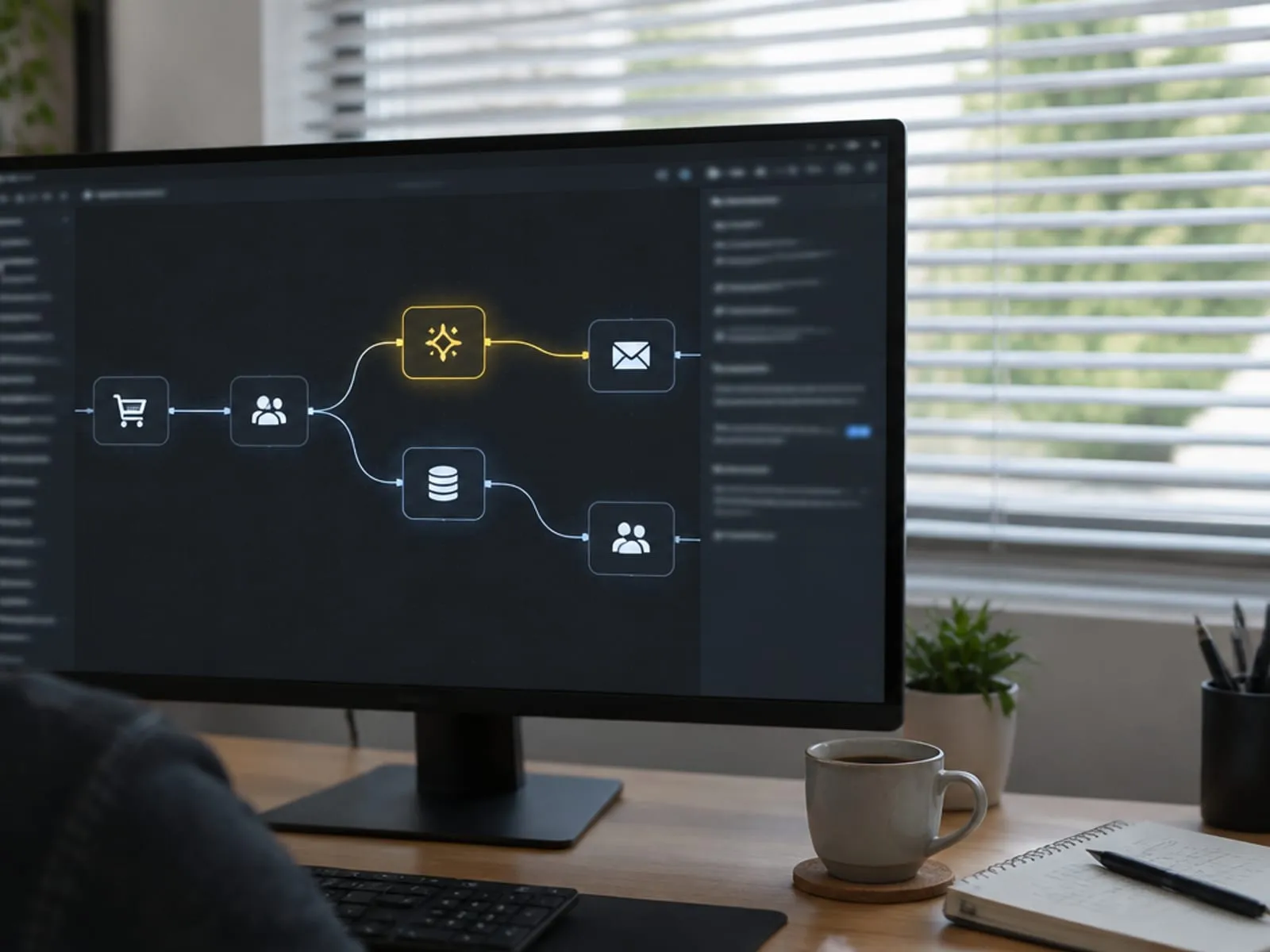
- 5. We act, with approval. The same chat triggers n8n workflows: opening a ticket, updating the CRM, preparing a draft. Actions that matter are approved by a person.
How we get there
THREE LEVERS, IN THIS ORDER
 01TrainingRole-based courses built on the company’s real cases: what you can ask AI, what you can’t, how to check an answer. Registers and certificates also help document the measures required by Article 4 of the AI Act.The Article 4 project
 02Automationsn8n flows that do the repetitive steps instead of people: sorting emails, extracting data from invoices and delivery notes, updating the CRM, preparing Monday’s report. They are the first visible result, often within a few weeks.Automation and n8n
 03AI hubThe central archive that answers with sources and, through the same workflows, starts actions. For staff it’s a chat inside the tools they already use. For customers, the same knowledge can power Conversly on your website.Conversly, for customers
Department by department
BEFORE AND AFTER
Today
For a quote, people hunt for price lists, data sheets and similar offers across emails and folders. When they can’t find them, they ask the colleague who “knows”.
With the second brain
“Prepare a quote for 200 units of model X for customer Y”: the hub pulls the history from the CRM, the current price list and the terms already agreed, writes the draft with sources and logs it in the CRM once you approve it.
Today
Every request is read by hand and the answer changes from one agent to the next. Order status means asking the warehouse.
With the second brain
Emails arrive already sorted, with a draft reply drawn from manuals, FAQs and the order status in the ERP. The agent edits and sends. New cases become entries in the knowledge base.
Today
Manuals, non-conformities and procedures sit in scattered PDFs. The real know-how is in senior staff’s heads, and they get interrupted all the time.
With the second brain
An operator asks “tightening torque for assembly Z, 2024 revision” and gets the value with a link to the page of the manual. A French industrial laboratory of about 200 people put an assistant like this into production in less than a month.
Today
Newcomers ask colleagues and HR about everything, and the same questions on holidays, safety and procedures come back every month.
With the second brain
An assistant answers by citing the policy or procedure. HR sees which questions keep coming back and updates the materials. In Italy, if AI is used in managing staff, law 132/2025 requires employees to be informed: we plan for it from the start.
Today
Briefs, tone of voice, product sheets and campaign results live in different places. Every piece of copy starts from scratch.
With the second brain
Drafts start from the official product sheets and the tone of voice written down once. Reports combine campaign numbers with sales notes, and case studies already written are easy to find again.
Today
Invoices and delivery notes are checked by hand. “Where are we with X’s payment?” goes through three people.
With the second brain
Data is extracted from documents and reconciliations arrive already proposed, ready to confirm. Payment status is a question for the hub, which reads it from the ERP. Document extraction is already the most common use of AI in Italy.
The path
HOW WE WORK
Indicative timings: they depend on how many sources need connecting and how tidy they are.
Off the shelf or custom-built?
THE RIGHT TOOL
Off the shelf
If almost everything lives in Microsoft 365 or Google Workspace and searching and writing is enough, Copilot or Gemini can be up and running in a few days. We help you set them up and train the team.
Custom-built
If ERP, CRM and tickets matter together, if you need actions and not just answers, if you want to choose the model and hosting. We build it with n8n, a vector database and the most suitable model.
Hybrid, often the most sensible
The suite for everyday work, plus an n8n hub for the processes and systems the suite can’t see.
Tools we work with: n8n, Make, OpenAI, Anthropic Claude, Google Gemini, Mistral, open-source models, Supabase and pgvector, Qdrant, Microsoft 365 Copilot.
To avoid misunderstandings
WHAT IT ISN’T, AND WHERE PROJECTS GO WRONG
What it isn’t
- We don’t train a model on your dataThe model stays as it is. It reads the documents when the question is asked: if a price list changes or disappears, the answer changes immediately.
- It doesn’t replace your ERP or CRMIt queries them and, when needed, updates them. Official data stays where it is today.
- It isn’t ChatGPT with your logoIt works only on your sources, respects everyone’s permissions and keeps track of who asked what.
- It isn’t infallibleIt makes fewer mistakes because it cites the source and can answer “I don’t know”. Where a mistake is costly, a person confirms.
The mistakes that make projects fail
According to Gartner, by 2026 60% of AI projects without AI-ready data will be abandoned. It’s almost never the model’s fault.
- 01Dirty dataThree versions of the same price list give three different answers. Before the pilot, you decide which is the official source for each topic.
- 02No ownerWithout someone keeping the sources up to date, after six months the hub answers with outdated documents.
- 03Permissions as an afterthoughtIf sales staff can read payslips, that’s a data leak. Permissions are inherited from the source systems and tested with different users.
- 04“Shadow” AIIf the company tool is awkward, people use personal accounts and data leaves the company. The internal alternative has to be easier.
- 05A project that’s too bigThe whole company at once never gets off the ground. One department and one process at a time, with a number to improve agreed in advance.
The first step is a small one
Let’s pick a process together and see how much time it frees up
The question that always comes up
What about our data?
It stays yours. Here’s how, point by point.
- Business accounts onlyWith the APIs and business plans of OpenAI, Anthropic and Microsoft, content isn’t used to train models. With personal accounts it often is.
- Hosting in Europe or on-premisesProviders’ EU data residency, European models such as Mistral, or open-source models and n8n on your own servers.
- AI Act, Article 4Since 2 February 2025 anyone using AI must take AI literacy measures for their staff. Authorities have been supervising since 2 August 2026.
- AI Act, Article 50Since 2 August 2026 people talking to a chatbot must know it’s an AI. This applies to customer-facing assistants.
- Italian law 132/2025In force since 10 October 2025: in Italy, if AI is used in managing the employment relationship, employees must be informed.
- GDPRData processing agreements with providers, minimal data, role-based permissions and, when needed, an impact assessment.
Questions we get asked
FREQUENTLY ASKED QUESTIONS
What is a company second brain?
It’s a single place where people in the company ask questions in natural language and get answers drawn from the company’s documents and systems, with a link to the source and respecting everyone’s permissions. From the same place you can start actions, such as opening a ticket or preparing a draft quote, through controlled automations.
Will our data be used to train ChatGPT or other models?
With business accounts and the APIs of OpenAI, Anthropic and Microsoft, content isn’t used to train models. With personal accounts it often is. That’s why we only work with business accounts and data processing agreements.
Where is the data stored?
You can choose hosting in the European Union (the main providers offer it) or your own servers with open-source models and n8n installed in-house, when the data is particularly sensitive.
How long before we see something?
A simple automation takes a few weeks. A hub pilot in one department, one or two months. The rest depends on how many sources need connecting and how tidy they are.
Do we have to change our ERP or CRM?
No. The hub connects to what you already have, through APIs or regular exports.
What if the AI gets it wrong?
It can happen. Every answer cites its source, so it can be checked in one click. Important actions require approval, and answer quality is measured over time against a set of test questions.
Will everyone see everything?
No. Everyone sees only what they would already see in the source systems. Permissions are designed from day one.
Are we required to provide AI training?
Article 4 of the AI Act, in force since 2 February 2025, requires those who use AI systems to take measures for their staff’s AI literacy; national authorities have been supervising since 2 August 2026. Under the 2026 Digital Omnibus no specific level or certificate is required, but it’s wise to document what you do.
Sources for the figures and regulatory references
- ISTAT, Enterprises and ICT, 2025 (in Italian)
- Eurostat, use of AI in EU enterprises (2025)
- Digital Innovation in SMEs Observatory, Politecnico di Milano (2026, in Italian)
- European Commission, AI literacy: questions and answers
- Future of Privacy Forum, AI Act timeline after the Digital Omnibus (2026)
- Italian law on artificial intelligence (Law 132/2025, in Italian)
- EASI-RAG, a RAG assistant in an industrial SME (arXiv, 2025)